Somewhere between the moment wind touches a blade and the moment your kettle boils, there's a chain of machinery most explanations skip. I've stood underneath a 2.5 MW turbine in a field outside a small coastal town, listening to a low hum that sounded less like machinery and more like a very large refrigerator, and I still had to look up how the electricity actually gets from those spinning blades into the grid. The answer is more interesting than "the wind pushes them and generators make power."
So here's what's really happening, step by step, including the parts that annoy people and the parts engineers quietly fix every single day.
Key Takeaways
- A modern turbine spins its blades at roughly 15-20 rotations per minute, but the generator needs around 1,500 rpm. A gearbox (or clever electronics) bridges that gap.
- Wind itself is a form of solar energy: the sun heats the atmosphere unevenly, and that temperature difference sets air in motion.
- The "clean" label applies to operation, not manufacturing. Steel, concrete, and rare earths all carry a carbon and energy cost upfront.
- Most commercial turbines pay back their embodied energy within a year and their carbon footprint within a few years.
- Turbines aren't just generators. They're controlled machines with pitch and yaw systems deciding, many times per second, whether to catch wind or shed it.
How wind turbines generate clean electricity, from blade to socket
The wind isn't "used up" the way coal is. It's kinetic energy that exists because the sun warms the equator more than the poles, and air rushes to balance that difference. That imbalance is the whole reason any of this works, and it's why wind is classified as renewable: as long as the sun shines, the atmosphere keeps stirring.
The step-by-step chain
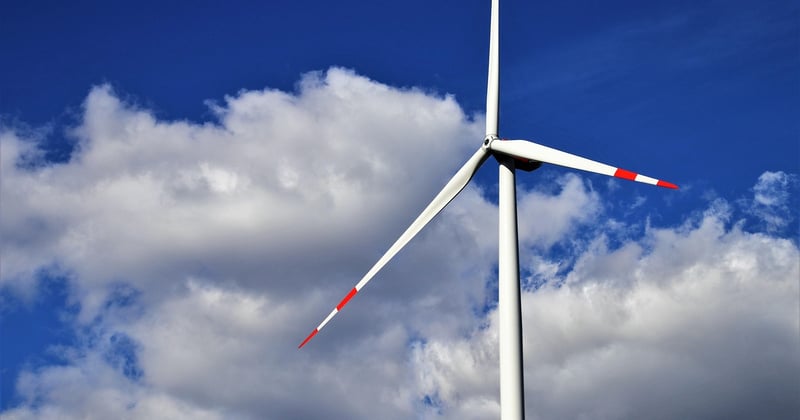
- Wind hits the blades. Their curved, aerofoil-shaped cross-section creates a pressure difference, just like an airplane wing. The blades don't get "pushed" so much as lifted around the rotor axis.
- The rotor turns a low-speed shaft. On a big machine, that's somewhere in the 15-20 rpm range. Slow. Almost lazy-looking from the ground.
- A gearbox steps the speed up. Depending on the design, output shaft speed climbs to roughly 1,500 rpm, which is what a standard generator needs to produce 50 or 60 Hz current.
- The generator converts rotation into electricity. Most utility-scale machines today use one of two approaches: a doubly-fed induction generator (DFIG), which stays connected to the grid and adjusts its own speed, or a permanent-magnet synchronous generator paired with a full power converter. Both work; the second is quieter and handles variable wind better.
- Power electronics clean up the output. This is the step almost nobody mentions. The raw electricity from a variable-speed generator is at the wrong frequency and varies too much for the grid. So it goes through a rectifier (AC to DC) and an inverter (DC back to AC at exactly grid frequency). Without this stage, turbines couldn't connect to a national grid at all.
Why the pitch and yaw systems matter more than people think
A turbine that only knew how to spin would tear itself apart in a storm. So it has two control systems working constantly:
Yaw keeps the nacelle — the box at the top holding the generator — pointed into the wind. Sensors measure direction, motors rotate the whole assembly by a few degrees at a time.
Pitch tilts each blade along its length. In light wind, the blades face the wind fully. As wind speed climbs past the machine's rated limit, the blades twist to spill air, and in extreme gusts they feather completely flat so the rotor almost stops. That's the difference between surviving a storm and losing a blade.
Do wind turbines produce clean energy?
Here's where I'll push back on the easy answer. Yes, operationally — no combustion, no CO2 out of the stack, no fuel trucks. But "clean" is doing a lot of work in that sentence, and I'd rather be honest about it than wave the flag.
A turbine is a few hundred tonnes of steel, concrete for the foundation, and a nacelle full of copper, electronics, and — on many permanent-magnet designs — rare-earth magnets. All of that has to be mined, refined, shipped, and assembled. That upfront cost is real and measurable.
What makes the label defensible is the payback math. Most commercial turbines offset the energy used to build them within roughly six to twelve months of operation, and the associated carbon within two to five years, depending on the local wind resource and grid mix. Over a 20-25 year service life, that's a lot of clean generation against a one-time construction debt.
The intermittency objection
Wind farms are criticised for producing power only when the wind blows. That's true. But researchers studying the problem keep pointing out that this variability is also an opportunity: unpredictable winds, extreme weather, and turbine wake effects (the disturbed airflow downstream of a turbine) are being studied as windows into how the atmosphere behaves. The argument goes that filling these gaps in knowledge makes future wind farms more reliable, not less. It's a fair point — you can't engineer around a phenomenon you don't understand.
What is the biggest problem with wind turbines?
If you ask ten engineers, you'll get three or four honest answers, and the loudest one on the news usually isn't the one they pick.
The technical answer is consistency. Turbines only produce when the wind blows, and wind isn't dispatchable the way a gas plant is. Grid operators have to balance the difference, using storage, fast-responding plants, interconnectors, or demand management. That's solvable engineering, but it costs money and coordination.
The other real problems are wake effects (upstream turbines rob downstream ones of wind), extreme weather (the reason pitch control exists), and local noise or visual concerns that fall outside engineering entirely.
I'll admit I used to lump "reliability" and "cost" together as the same complaint. They're not. The cost of wind generation has fallen dramatically over the last two decades; the reliability question is a systems problem, not a turbine problem.
Does a wind turbine pay for itself in its lifetime?
Financially, yes — for utility-scale machines, easily. A commercial turbine typically earns back its capital cost within its first several years of operation if sited well, then generates for another 15-20 years on top of that. That's the whole reason developers build them.

For a home-sized turbine, the honest answer is it depends, and often not. Small rooftop or backyard turbines rarely get the same consistent wind a ridge-top commercial site gets, their maintenance is proportionally more expensive, and plenty of installs quietly underperform. I've seen small-turbine owners who love their setup and others who told me they'd rather have spent the money on solar panels. Where you live matters more than the turbine spec sheet.
| Scale | Typical output | Financial payback reality |
|---|---|---|
| Utility turbine (2-3 MW) | Several GWh per year at a good site | Recovers capital within a few years |
| Community turbine (100-500 kW) | Hundreds of MWh per year | Payback depends heavily on subsidy and site |
| Home turbine (1-10 kW) | Feeds a single building | Often 10+ years, sometimes never |
Why does Trump dislike wind turbines?
He has said it plainly for years, and it's a position, not a technical argument. The recurring complaints from him and from people who share his view are visual and personal: he has objected to turbines visible from his Scottish golf course, called them ugly, claimed they kill birds in large numbers, and repeated the idea that they cause health problems for people living nearby. He's also tied them to higher energy costs.
It's worth separating the claims. Bird mortality from turbines is real but small compared to other causes of bird death; the "wind turbine syndrome" health claim has been studied repeatedly and hasn't held up. Visual impact and cost arguments are fairer ground. So when you hear the criticism, it helps to know which bucket each point falls into — aesthetics and economics are debatable, health effects are not, on the current evidence.
How much power does a wind turbine produce per day?
A modern 2-3 MW turbine at a good site averages somewhere around 40-60% of its rated capacity over a year, which works out to roughly 20-35 MWh on an average day. That's enough to cover the daily usage of a few thousand homes. On a still day, zero.
Do wind turbines need electricity to start?
They don't need a starter motor. The wind itself spins the rotor. But controls, yaw motors, pitch actuators, and the power electronics need a small amount of power to operate — usually drawn from the grid or a small backup supply when the turbine is idle.
The part that actually stays with you
Wind turbines are usually sold as a story about blades spinning. The more interesting story is the second half: gearboxes stepping 18 rpm into 1,500, power electronics fighting to match grid frequency, pitch systems feathering blades in a gust so quietly you'd never know a decision was made. All of that happens without a turbine of fuel being burned, and it happens because the sun unevenly warms a planet with an atmosphere.
The next time you see one on a ridge, look at whether its blades are tilted away from the wind. If they are, it's telling you something about the weather nobody else noticed.