Stand on a patch of tundra near the Arctic coast in late August and the ground gives slightly under your boot, like a mattress with a broken spring. That softness is the whole story. You are standing on what was, until recently, permanently frozen ground. The ice that held it together is leaving, and as it goes, it is handing a colossal amount of carbon back to the atmosphere. Permafrost thaw and its role in carbon emissions is not a niche academic footnote. It is one of those processes where the ground itself becomes a source, and we still do not have a clean number for how big that source will get.
I first went down this rabbit hole while comparing permafrost carbon estimates for a project, thinking I would knock it out in an afternoon. Two weeks later I was still untangling the difference between how much carbon is locked in the ground and how much actually escapes each year. Spoiler: those are very different numbers, and conflating them is the most common mistake I see.
Key Takeaways
- Permafrost holds a frozen carbon stock on the order of 1,400 to 1,600 billion tonnes — roughly twice what is currently in the atmosphere.
- The carbon leaves the ground as both CO₂ and methane, and methane's far stronger warming effect makes the gas mix matter enormously.
- The dangerous part is not steady thaw but abrupt thaw: ground collapse, thermokarst, and slumps that expose deep ancient carbon fast.
- How much carbon actually reaches the atmosphere each year is genuinely uncertain, and honest projections stay wide on purpose.
- You cannot "stop" permafrost thaw with a local fix once the regional climate has shifted. Emissions reduction is the only lever that scales.
- Abrupt thaw is where most models are weakest, which means the risk is more likely understated than exaggerated.
How permafrost thaw turns frozen ground into a carbon emissions source
The frozen layer we call permafrost is defined by a simple condition: ground that stays at or below 0°C for at least two consecutive years. Above it sits the active layer, the top slice that thaws every summer and refreezes each winter. Everything living and dying — roots, moss, peat — happens in that active layer and just below it, and for tens of thousands of years the cold kept the dead stuff from fully rotting.
Here is the mechanism in plain terms. When organic material stays frozen, microbes cannot break it down, so carbon accumulates instead of cycling back out. The ground becomes a vault. Warm the vault past freezing, and the microbes wake up, eat the thawed organic matter, and exhale carbon dioxide — or methane, depending on how wet and oxygen-starved the spot is. That exhale is the emission.
A colleague once described it as a freezer versus a kitchen counter, and it stuck with me. Food left in a freezer stays food for years. Move it to the counter and it turns into something else within days. Permafrost is the freezer. Thaw is the counter.
How does permafrost form?
It forms wherever the mean annual ground temperature stays at or below freezing long enough for the cold to penetrate deep. That happens across large stretches of Siberia, Alaska, northern Canada, and the Tibetan Plateau, and it is why the same latitude can be frozen in one spot and not in another: snow cover, vegetation, soil type, and drainage all change how well the ground holds its cold. Thick snow insulates the ground in winter and can actually keep it warmer. Bare, wind-scoured ground loses heat and stays frozen harder. Depth matters too. Some permafrost extends hundreds of metres down and has been frozen since before the last ice age — a fact I find genuinely strange to sit with.
How much carbon is stored in permafrost?
The widely used figure sits in the range of 1,400 to 1,600 billion tonnes of carbon, with some estimates nudging toward 1,700. To put that in context, that is roughly double the carbon currently held in the entire atmosphere. A large share of it is not scattered evenly — it is concentrated in the deep, ice-rich yedoma deposits that accumulated over millennia in Siberia and Alaska.
Two things trip people up. First, "stored" does not mean any of it will thaw. Second, even if it thaws, not all of it decays within a human lifetime — some carbon refreezes, some washes into rivers, some gets buried again. The stock is enormous; the flow out of it is a much smaller, slower number.
| Layer | What it holds | Behaviour when it thaws |
|---|---|---|
| Active layer (top 0.3–2 m) | Recent plant material, roots, peat | Thaws every summer already; contributes steady seasonal emissions |
| Shallow permafrost | Older frozen organic matter | Thaws over years to decades; gradual CO₂ release |
| Ice-rich deep permafrost | Ancient yedoma carbon, wedge ice | Prone to abrupt collapse; fast, uneven release and methane pockets |
The distinction matters because most of the public conversation treats permafrost as one uniform block. It is not. Where the carbon sits, and how fast the ice holding it together disappears, decides whether you get a slow seep or a sudden hole in the ground.
Is permafrost a carbon sink or a carbon source?
Both, depending on the timescale you are asking about — and this is the point where I got annoyed at my own early note-taking, because I kept writing "sink" in one paragraph and "source" in the next without noticing they were answering different questions.
Over the long run, permafrost has been a net carbon sink. Cold, waterlogged conditions slow decomposition, so dead plant matter piled up faster than it rotted. That is precisely why so much carbon is there in the first place. The vault filled because the door stayed shut.
Now flip the condition. Push the ground past freezing and the accounting reverses: decomposition speeds up, and the ground starts losing carbon faster than it takes it in. That makes thawed permafrost a net source. The climate system does not care which label we prefer. It only cares about the direction of the flow, and the direction has changed.
Why is permafrost important?
Because it is a store that, once disturbed, feeds back into the very warming causing the disturbance. A warmer climate thaws more ground. More thaw means more decomposition. More decomposition means more greenhouse gas. That is the permafrost carbon feedback, and it is why permafrost shows up in climate projections at all rather than being treated as a curiosity.
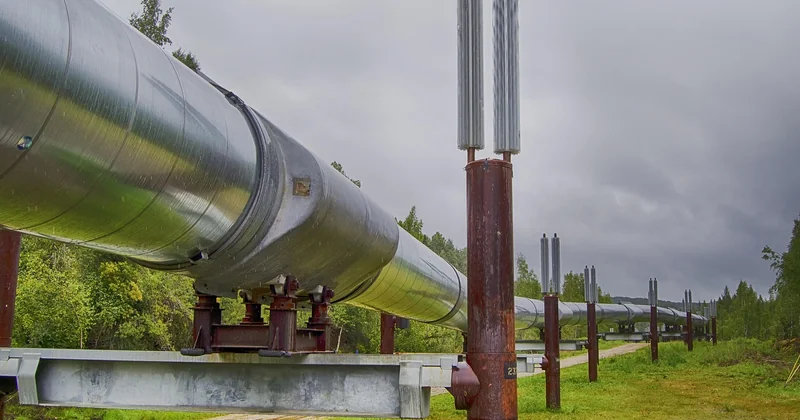
There is a second reason people often miss. Permafrost is structural. It holds up buildings, roads, pipelines, and entire towns built on frozen ground. When it softens, the ground shifts, and infrastructure fails in ways that have nothing to do with emissions but everything to do with how quickly the thaw is arriving.
Why methane versus CO₂ changes the size of the problem
Thaw does not release one tidy gas. In dry, well-drained soils, microbes produce mostly carbon dioxide. In waterlogged, oxygen-poor soils — think of the drained lake basins and saturated bogs that thaw creates — they produce methane instead.
Methane is the wildcard. Molecule for molecule it traps far more heat than CO₂ over the short term, even though it leaves the atmosphere faster. So the same amount of thawed carbon can have a very different warming impact depending on whether it comes out as CO₂ or as methane. The wetter the thaw, the worse the near-term effect. I find this the single most under-reported part of the whole story, because a number like "X billion tonnes of carbon" tells you nothing about impact until you know the gas mix.
Abrupt thaw: the part most models handle badly
Picture a hillside in the Arctic that has been frozen for thousands of years. A warm summer eats through the ice wedges holding the slope together, and the ground does not gently lower. It collapses. A chunk of hillside slides away, exposing deep, ancient carbon to the air and water for the first time. That is abrupt thaw, and it is different in kind from the slow, incremental thawing that dominates most projections.
Two things make abrupt thaw a problem. First, it exposes deep carbon that gradual thawing would take decades or centuries to reach. Second, it happens in patches, which means it is hard to represent in the grid-scale models used for climate projections. Gradual thaw, in effect, is what those models see. The slumps, ponds, and ground collapse largely are not. When a process is systematically missing from a model, the risk tends to be understated, not exaggerated.
How fast is thaw arriving?
Faster in some places than the average suggests, which is the honest way to put it without inventing numbers. What you can say is that the direction and the general acceleration are well established, while the exact rate in any given region is not. Anyone who hands you a single clean figure for total current emissions from thawed permafrost is either quoting one narrow study or rounding away the uncertainty.
How to stop permafrost melting
This is the question that breaks people's optimism, so I will be blunt. There is no local fix that scales. You can insulate a building foundation with thermosiphons that pull heat out of the ground, and engineers do exactly that to keep infrastructure standing. You can shade the ground, manage vegetation, or refreeze a specific patch. None of that stops regional thaw, because the thaw is driven by air temperature over enormous areas, not by what happens to one lot.
The only lever that operates at the scale of the problem is cutting the emissions that drive the warming in the first place. That is an unsatisfying answer for someone hoping for a tidy remedy, but it is the accurate one. Local engineering protects assets. Global emissions reduction protects the ground.
What the thaw actually asks of you
Here is the part I keep coming back to. Permafrost thaw is not a switch that flips. It is a slow leak that gets faster the warmer it gets, and the carbon that comes out is the same carbon that was safely stored for millennia. The stock is roughly twice the atmosphere's current load. The flow out of it so far is a small fraction of that, and the projections for the coming decades are wide by necessity.
Wide is not the same as safe. The uncertainty runs in both directions, but the part of the system we understand least — the abrupt, messy, ground-collapsing thaw — is the part most likely to be missing from the reassuring end of the range. If you take one thing away, take the direction: the vault is opening, and how far depends on how much more we warm the air above it.
The ground under your boot in that tundra does not care about the labels we assign it. It is simply doing what warmer ground does.