Someone asked me last month why I bother cooking lentils when a chicken breast costs less per kilo. Fair question. And the honest answer is that the lentils aren't the point — the point is what the chicken breast actually costs, once you stop looking at the shelf price and start looking at what it takes to get it there.
Most people who want to eat more sustainably aren't confused about whether they should. They're confused about which swaps actually matter. That's the gap I want to close here, because I've made most of the mistakes in this category, and I've got the grocery receipts to prove it.
Key takeaways
- Food production accounts for roughly a third of global greenhouse gas emissions, and livestock is the single biggest contributor within that.
- Beef and lamb carry an emissions footprint several times higher per kilo than pork or poultry, and 10 to 50 times that of most plant proteins.
- You don't need to go vegetarian. Cutting beef from three meals a week to one does more than going vegan for a fortnight and quitting.
- The swaps that stick are the ones that change your default menu, not your willpower.
- "Meat reduction sauce" — I checked, people really do search that, and no, it isn't a culinary technique. I address it below.
Sustainable food choices and lowering meat consumption: what actually moves the needle
Here's the thing nobody tells you when they hand you a reusable tote bag and a list of "eco-friendly" swaps: the food on your plate is the highest-leverage thing you touch every single day. Transport, packaging, plastic straws — these get enormous attention because they're easy to visualise. But agriculture eats a far bigger slice of the pie.
Why food is the biggest lever most households have
Roughly a third of global greenhouse gas emissions tied to human activity come from food systems. Within that, livestock is the heaviest component — methane from ruminant digestion, nitrous oxide from fertiliser used to grow feed, plus the land cleared to grow that feed in the first place.
What makes this different from, say, aviation or manufacturing is that you decide about it three times a day. No policy change required. No new infrastructure. Just a decision at the shop.
The catch? Those decisions are habit, not reasoning. I know this because I tried to reason my way through it. I made a spreadsheet. Of course I made a spreadsheet.
The footprint gap between meats is bigger than most people assume
This is where the conversation usually gets vague, so let me be concrete. The range between protein sources isn't subtle. It's the difference between a bicycle and a delivery van.
| Protein source | Rough CO₂e per kg | Land use | Practical note |
|---|---|---|---|
| Beef (especially grass-fed) | Highest of the common meats | Large | Ruminant methane is the main driver |
| Lamb | Comparable to beef | Large | Similar digestive profile |
| Pork | Roughly a quarter of beef | Moderate | Monogastric, no enteric methane |
| Chicken | Lower still | Smaller | Best conversion ratio among common meats |
| Eggs | Below chicken per gram of protein | Small | Useful bridge food |
| Lentils, beans, peas | A small fraction of any meat | Tiny | Also fixes nitrogen in soil |
| Tofu and other soy | Very low | Tiny | Protein density close to meat |
I'm deliberately not giving you precise kilogram figures, because those numbers vary enormously depending on whether the animal was raised on deforested pasture, on marginal grassland, or in a barn on imported soy. Anyone quoting you one clean number for "beef" is overselling the precision.
The ordering, though, is stable across every credible assessment I've read. Ruminants sit at the top by a wide margin. Plants sit at the bottom by an even wider one. That ordering is the whole story.
What this means for your week
If you eat beef four times a week and swapped two of those meals for chicken and one for beans, you'd cut more from your food footprint than someone who goes fully vegetarian but replaces every meat dish with imported cheese and air-freighted asparagus. The substitution matters as much as the reduction.
This is the part the "eat less meat" messaging tends to skip. Reduction without substitution is a diet. Reduction with substitution is a change.
How to reduce meat consumption without white-knuckling it
I'll be blunt: willpower-based approaches fail, and I say that as someone who failed at several of them. What worked, eventually, was changing what was already in the fridge.

Change the default, not the desire
Nobody craves beef because they ran a cost-benefit analysis. They eat it because it's the thing that's there, or the thing on the menu they always order. So attack the default directly:
- Reorder your online grocery basket. Put the pulses and tofu where the mince used to sit. One-time effort, permanent effect.
- Pick two dinners a week that are already meatless in your repertoire. Not new recipes — existing ones. Less friction.
- Buy meat in smaller quantities but better quality. Same weekly spend, lower volume, and you'll actually notice the meal.
- Keep one frozen plant-protein option on hand for the nights you'd otherwise order in.
- Don't announce it to your household as a project. Just cook it.
The awkward truth is that the loudest "I'm going plant-based" declarations I've witnessed lasted about eleven days. The quiet ones lasted years.
What about protein, and the "stop eating meat side effects" worry
People ask me this constantly, usually in the tone of someone expecting a horror story. The realistic side effects of cutting back on meat are: you eat more fibre, you probably eat less saturated fat, and you might feel hungrier for the first fortnight if you simply removed the meat without replacing the protein.
That last one is the only real trap. Remove 30 grams of protein from a meal and don't put anything back, and yes, you'll be raiding the cupboard at 4pm. Add beans, lentils, eggs, Greek yoghurt, tofu, or a larger portion of whatever plant protein you like, and the problem mostly disappears.
Anyone claiming dramatic health consequences from eating less meat is usually describing a badly constructed diet, not a low-meat one. If you have a medical condition, that's a conversation for your doctor, not for me.
Why should we be eating less meat for the environment?
Three mechanisms, and they compound.

Land, and what gets cleared to make room
Livestock occupies the majority of agricultural land worldwide, and a large share of that is pasture that could support other uses. When demand pushes into forested regions, the carbon released in clearing that land is a one-time hit that takes decades to repay. This is where beef's footprint gets genuinely ugly in some supply chains.
Methane and the short-term clock
Methane behaves differently from carbon dioxide. It doesn't linger for centuries, but while it's in the atmosphere it traps heat far more aggressively per molecule. That combination — intense but relatively short-lived — means cutting ruminant numbers produces a measurable cooling effect within a human lifetime rather than a geological one. That's unusual, and it's a big part of why livestock keeps appearing at the top of these discussions.
Feed conversion, or the detour problem
Every kilo of animal protein requires several kilos of plant protein as feed. You're running calories through an animal before they reach your plate. For chicken and eggs, that conversion is reasonably efficient. For beef, it's dramatically worse. From a pure resource standpoint, feeding grain to cattle and then eating the cattle is the long way round.
Put those three together and the case is straightforward. Not because meat is evil — because the volume most high-income countries currently eat is several times what the land and atmosphere can absorb without strain.
The "meat reduction sauce" question, answered properly
I have to address this, because it comes up and it's a genuine search term with a genuinely confusing name.
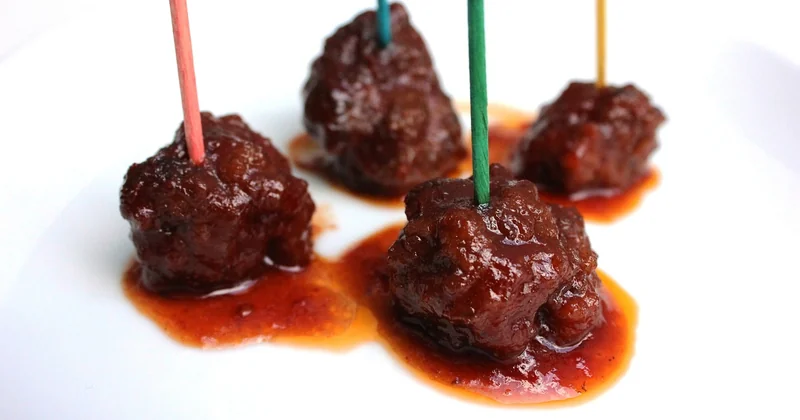
"Meat reduction sauce" is a culinary technique, not an environmental strategy. A reduction sauce is made by simmering stock or pan juices until the liquid concentrates and thickens — a classic French method, the base of a demi-glace. If you're looking for how to make one, that's what it means, and it has nothing to do with eating less meat.
If you're looking for how to reduce meat, the answer is in the section above. If you're looking for a sauce to serve with a smaller portion of meat, a proper reduction is genuinely useful — it makes 120 grams of beef feel like a real meal rather than a ration. Which, honestly, might be the most practical tip in this entire piece.
What actually changes behaviour
I've watched this debate for years, and the intervention that works is rarely the one that sounds most persuasive.
Information campaigns move attitudes and barely touch plates. Price signals move plates, but they're outside your control as a shopper. What sits in the middle, and what you can act on today, is menu design — your own and the ones you order from.
Canteens that put the plant option first, without labelling it as the "sustainable" choice, see uptake rise. Supermarkets that place plant proteins at eye level sell more of them. Restaurants that make the veggie dish the default on a set menu get more orders. None of that relies on anyone caring about emissions.
There's also a cultural point that Western coverage tends to flatten. In large parts of the world, meat was never a daily staple to begin with — the question there is about affordability and nutrition, not reduction. Framing this as a universal "eat less meat" mandate misreads most of the planet.
A quick note on context
If you live somewhere meat has always been a weekly rather than daily event, none of this is a sacrifice. It's already your baseline. The burden of change sits with high-consumption countries, and pretending otherwise is how these conversations lose people before they start.
Where I landed
My own kitchen ended up somewhere unglamorous: beef once a week, chicken or fish a couple of times, and the rest of the week built around pulses, eggs, and whatever vegetables looked decent. I didn't plan it that way. It accumulated.
What surprised me is that the number on the receipt went down, not up. Plant proteins are cheap, and once you stop buying meat as the anchor of every meal, the whole basket shifts.
The thing I keep coming back to is that this isn't really a question of giving something up. It's a question of whether the version of dinner you've always cooked is the best one available, or just the one you learned first. Most of us never actually tested the alternatives. We assumed.
And assuming is the only part of this that genuinely costs you nothing — which is precisely why it's so easy to keep doing.